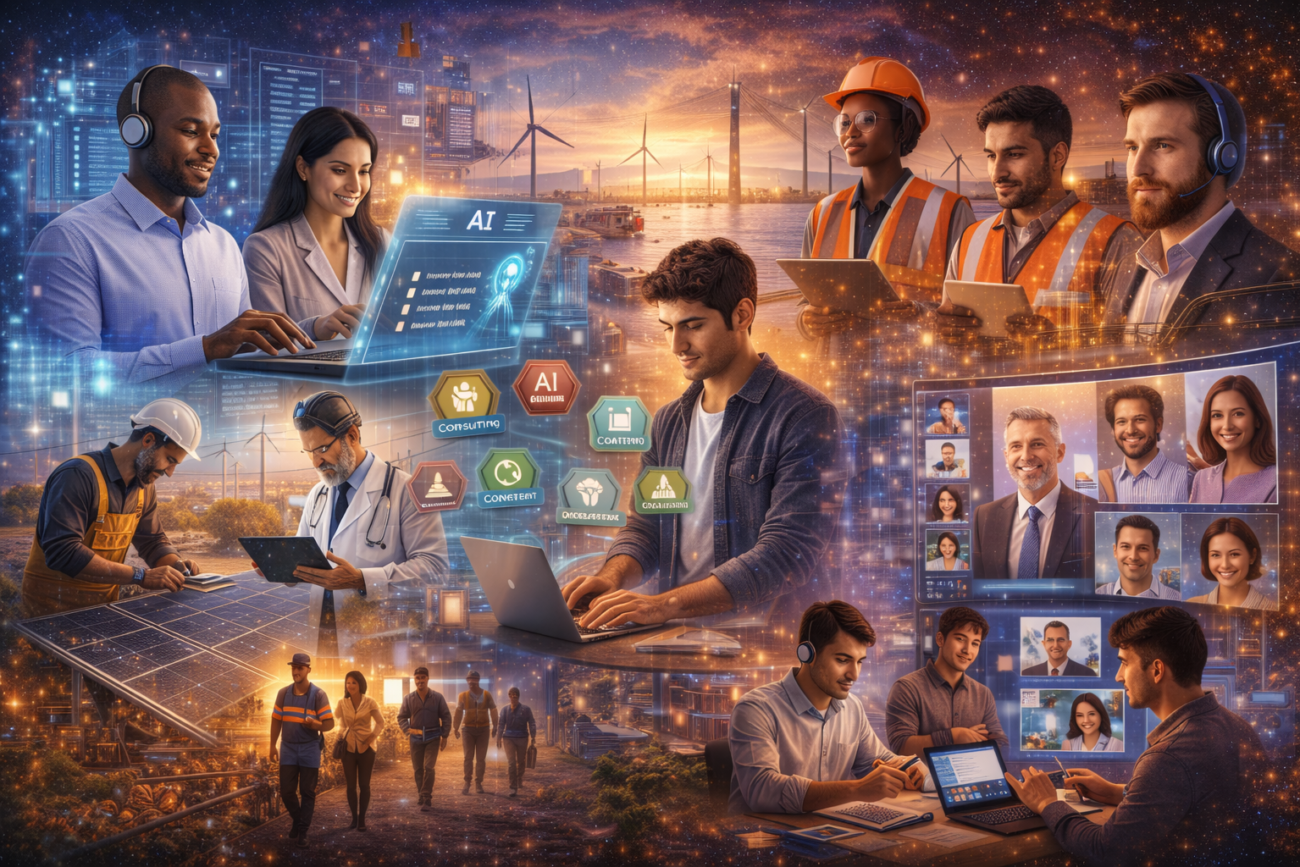
The job market in 2026 reveals a landscape transformed by artificial intelligence, where routine cognitive work diminishes while demand surges for uniquely human skills like creativity, empathy, and complex problem-solving. Traditional office roles in data entry, basic analysis, and customer scripting face steep declines as AI agents handle these tasks with greater speed and accuracy. Meanwhile, sectors like healthcare, renewable energy, and digital infrastructure experience acute talent shortages, driving wage premiums for skilled workers who can bridge technology and human needs.
AI fluency emerges as the foundational career competency, comparable to digital literacy in the 2010s, required across nearly every profession from marketing to manufacturing. Professionals who master prompt engineering, ethical AI deployment, and system integration command premium salaries and job security, with demand growing 40% annually in enterprise settings. Forward-thinking companies prioritize “AI whisperers”—workers who coax optimal performance from large language models while maintaining human oversight on critical outputs. This shift compels mid-career professionals to pursue continuous micro-credentials rather than relying on static degrees.
Gig and contract work evolves into sophisticated “portfolio careers,” where individuals assemble income from multiple streams including consulting, content creation, and specialized AI tool development. Platforms facilitate seamless matching of interim experts with project-specific needs, particularly in tech-driven transformations where companies prefer flexibility over permanent hires. For younger workers, this model offers accelerated learning through diverse exposures, though it demands rigorous personal branding and financial discipline to navigate income volatility.
Remote and hybrid arrangements solidify as permanent fixtures, augmented by spatial computing tools that create persistent virtual offices indistinguishable from physical spaces. Spatial audio meetings, holographic collaborations, and AI-summarized interactions eliminate geographic barriers, enabling talent pools from Narnaund to New York to compete equally. However, this democratization intensifies competition, forcing workers to cultivate distinctive personal narratives and niche expertise to stand out amid global abundance.
Sustainability-focused careers explode as governments and corporations race toward net-zero commitments, creating millions of roles in green engineering, carbon accounting, and circular economy design. Battery technicians, offshore wind specialists, and biomaterials engineers emerge as high-demand trades, often requiring shorter training paths than traditional university routes. These positions appeal particularly to hands-on learners seeking purpose-driven work with tangible environmental impact, bridging blue-collar stability with white-collar earning potential.
Mental resilience and lifelong learning become explicit hiring criteria as workplace stress from rapid change reaches record levels. Companies implement “cognitive fitness” programs combining neurofeedback training, mindfulness protocols, and personalized upskilling paths powered by adaptive AI coaches. Forward-thinking HR leaders measure candidate “adaptability quotients” alongside technical skills, recognizing that the ability to unlearn outdated methods determines long-term employability more than initial expertise.
India’s job market exemplifies these global currents, with Tier-2 cities like those in Haryana becoming innovation hubs through government-backed digital skilling initiatives and 5G infrastructure. Rural youth gain access to remote coding bootcamps, AI ethics certifications, and virtual internships connecting them directly to multinational opportunities. As automation displaces agricultural labor, reskilling programs emphasizing drone operation, precision farming analytics, and supply chain optimization create viable pathways to urban-equivalent prosperity without relocation.
